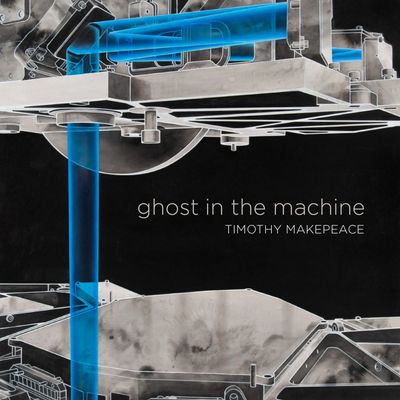
Objects in Mirror Are Closer Than They Appear
Tim Makepeace is a protean artist who has worked in photography, drawing, painting, sculpture and architectural drafting, as well as various combinations of these. His subjects range from gritty industrial infrastructure to his current fascination: the James Webb Space Telescope.
In a wide-ranging career, it’s not a single look that he is after, but rather a singular idea.
That, at least, is what he told The Washington Post 25 years ago. Yet over a career in which his attention has turned from the high voltage wires, coal terminals, water towers, silos and other begrimed behemoths of the post-machine-age American wasteland to the most powerful infrared space observatory ever devised, those words remain as true today as they did then.
So what is he looking for?
His pursuit is of something ineffable: an intangible, even unnameable transcendence that is not to be found in the grand, untamed landscapes that once captivated Albert Bierstadt and his peers but in what man has built. He has proven himself, over time, to be an obsessive connoisseur of the concrete.
In 2017, as part of NASA’s public outreach, Makepeace was invited, along with several other artists, to create art inspired by the Webb telescope while it was still under construction at the Goddard Space Flight Center in Greenbelt, Md. Launched on Christmas Day, 2021, the telescope is now traveling through space, one million miles from Earth, on a mission to gather information about the farthest reaches of the visible universe.
This exquisite technological marvel (which Makepeace likes to call “the epitome of all the machines humanity has ever made”) has consumed him ever since. Not just what it looks like, but, more importantly, what it does and the questions it raises: What is the relation between the physical and ephemeral; space and time; the finite and the infinite; the cosmic scale and the subatomic? Do we loom large or small in an expanse whose boundaries we have not even begun to define?
It is no accident, for this most curious of artists, that a telescope is itself a tool of looking. One this powerful is also, as Makepeace points out, a kind of time machine. Light takes time to travel across space, he explains, meaning that we observe distant objects as they appeared in the past, not as they appear today. Looking deeper into the universe allows us to see light from millions — or billions — of years ago.
As he always has, Makepeace was looking for something less obvious.
He began, as ever, with the object itself, taking photographs of the telescope’s dominant visual element: the 21-foot-wide gold-plated primary mirror, designed to collect and focus light from far away stars. Here, those photos have been rendered as a series of charcoal-and-pastel drawings, highlighting the mirror’s reflectivity. The reflections are of the room in which it was being built, as well as of the telescope itself, accentuating its quasi-abstract sculptural qualities.
A mirror is also an excellent metaphor. In a poetic sense, a mirror can represent a kind of magical portal. (Think Lewis Carroll.) In a more prosaic way, the mirror is emblematic of the exhibition itself—a portal to other worlds but something more if we allow it.
When we stand in front of a mirror, we can be faced with observations, realizations, and contradictions, often about ourselves. Tim’s work illustrates this, dancing between abstraction and representation, intimacy and immensity, the material world and its immaterial presence.
One drawing in the show,” Kapton Membrane on Spacecraft Bus # 3,” is shown side-by-side with its mirrored twin — Makepeace calls it an “echo,” and explains that it is a stencil, or cartoon, that was used to make the first image. You can see the artist’s fingerprints, in smudged charcoal, all over it, like residue of the process of its creation. Its inclusion in the show seems to be a way of saying, “Look. I am here. I’ve been here all along.”
Over time, Makepeace’s JWST-inspired work has grown to encompass much more than pictures of the telescope itself. Makepeace centers himself not just as someone whose connection to the telescope runs deep, but at times affords us a perspective from the point of view of the telescope itself — both voyager and voyeur. He creates works like the star trails by placing himself in a position to trace the paths and locate the telescope in that trajectory. He devises tools to record the orbit of the telescope. He has become the voice of the machine and is inviting us to listen and see.
He has painted the supermassive black hole, Sagittarius A*, at the center of our Milky Way. Also, he has created trippy, light-show fantasias — “ethereal sculpture made out of photons,” he calls them — based on the interplay of light bouncing off the telescope’s mirrors.
It’s the stuff of science, but also of dreams: not just wonky but wonderful (meaning full of wonder).
The critic Mark Jenkins once wrote of Makepeace’s images of industrial architecture that the artist renders “the commonplace sublime.” That’s true here too, except that there’s nothing commonplace about the Webb telescope. In an exhibition that tries to convey a sense of boundlessness — a show that aims to evoke even a fear-inducing sense of awe and grandeur about the cosmos — some might see a trace of the divine.
That isn’t the artist’s intent. Man, in the form of the scientists and engineers who designed and built the Webb telescope, is the only creator, lowercase c, whom Makepeace venerates.
There is of course, a parallel between the genius of those whose handiwork is at the center of “Ghost in the Machine” and Makepeace himself, who invents new ways of looking at — and thinking about — the entirety of the visible universe. By lavishing his single-minded scrutiny on a single subject, he ends up not worshipping an idol of technology but rather paying homage to the spirit of inquiry that inspired its creation, imbuing this machine with a kind of specialness — an aura — that supersedes its function.
He seems to allow us, even encourage us, to connect to something external, solid, grandiose. It might be easier and less painful than listening to the ghost in our own machine. Quiet voices inside all of us that seek connection, love, pleasure and pain. That laugh, cry, grieve, lose, languish, succeed.
Yet he also seems to suggest that if we stand in front of the work, like the mirrors in the show, and tune out the noise all around us and wait, we might find the answers we are seeking somewhere in the space between. That we might be reminded, as forgers of this golden device perched high above, of both our own awesomeness and our own smallness in the infinite space of the universe.
It is man who is Makepeace’s true subject. And that’s a transcendent enough idea.
Thomas Drymon
Michael O’Sullivan